

Your Body Is Not the Enemy: Emotional Regulation and Understanding your Nervous System
By Sarah Hall - Greenville Counseling Associates
When emotions feel overwhelming, it can seem like your body is working against you. But what if those reactions are actually your nervous system trying to protect you? Have you ever wondered why certain moments trigger such strong reactions? Sometimes it feels like the smallest things set us off. Your heart starts racing, your chest tightens, and suddenly you’re flooded with panic or rage. Maybe the baby is crying, dogs are barking and your toddler dumps hot sauce all over your dinner you just spent an hour preparing, then you snap! Maybe you’re eight minutes late in traffic and panic starts rising in your body. Suddenly you’re driving like you’re in an action movie and your life depends on it. You may find yourself staying in your room doomscrolling on your phone to avoid the loads of unfolded laundry, dishes in the sink, and projects you’ve been meaning to finish for weeks.

Window of Tolerance
These reactions are examples of what therapists call dysregulation—when the nervous system moves outside its normal balance. Understanding how your nervous system works can help you respond differently in those moments. In this post we will explore the Window of Tolerance, how the nervous system responds to stress, and three practical steps you can use to return to regulation.
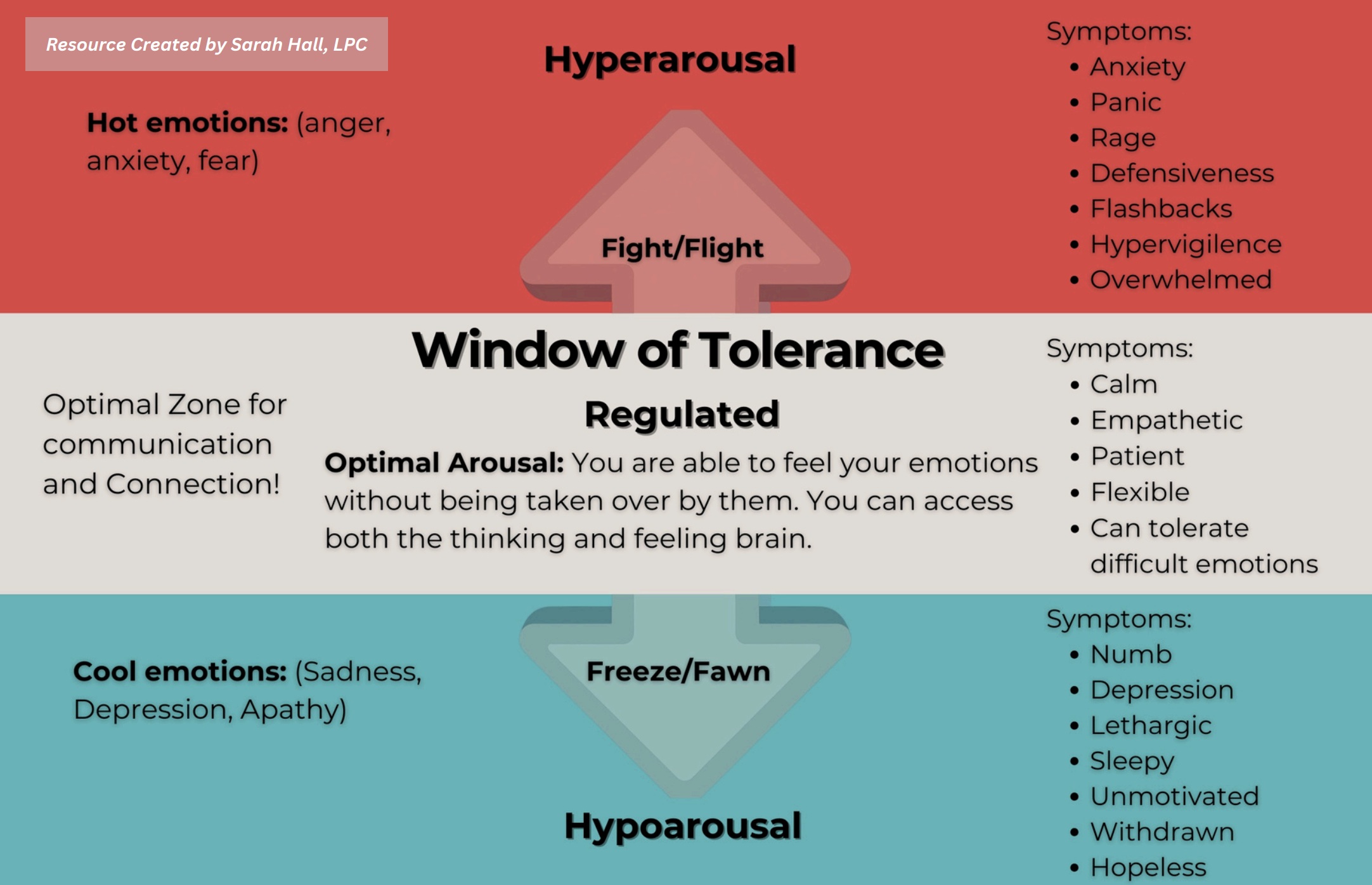
Dysregulation is not a personal failure—it’s your body trying to keep you safe. When your nervous system is on high alert, emotions and physical sensations can feel overwhelming. In those moments it may feel like your body is the enemy, but it is actually trying to protect you. This can happen in times of high stress, after a traumatic event or because of chronic childhood trauma. These events all can narrow that window of tolerance, which gives little space for you to stay regulated when stressors in life come. Emotional regulation happens when we attune to our nervous system and give it what it needs to feel safe. Over time, this helps widen our window of tolerance and brings our thinking brain back online. (See figure below).
Nervous System
Regulation isn’t about forcing yourself to feel calm. It’s about understanding your nervous system, noticing what’s happening underneath the symptoms, and giving your body what it needs to feel safe again. To understand your nervous system we must understand its different functions. The Autonomic Nervous System (ANS) controls many of the body’s automatic functions such as breathing, heart rate, and digestion. The ANS has two parts, the sympathetic and the parasympathetic.
The sympathetic system can be described as the body’s accelerator. It activates the body’s internal alarm system—the Fight-or-Flight Response—by releasing adrenaline and cortisol to mobilize us to fight or run from a threat. If this is activated you may feel anger, rage, anxiety, panic, overwhelm, or hypervigilance.
The parasympathetic system acts more like the body’s braking system. In some cases, when the brain senses overwhelming danger, the body may enter a shutdown or freeze response. When this freeze response is triggered you may feel numb, depressed, lethargic, sleepy, unmotivated, withdrawn or hopeless. This is your brain’s way of protecting you from things that feel too overwhelming for it to handle. The fawn response is a little more subtle, Aundi Kolber in her book Try Softer describes this as, “our body’s attempt to neutralize prolonged danger by pleasing or accommodating others rather than acknowledging our discomfort.”
After stressful seasons or traumatic events the world is experienced through a very different nervous system. The good news is that our nervous systems can learn new patterns and become more regulated over time.
Tools to Regulate
How do I regulate my nervous system? Remember the three R’s: Recognize, Regulate and Respond.
Recognize
There is great power found in being able to tune in to your nervous system and name what you are feeling and it is the first step in being able to regulate your emotions. First recognize that you are dysregulated or triggered and name the feeling you are experiencing. Say it out loud if you can:
“I’m having an emotional reaction.”
“I feel triggered right now.”
It helps to hear yourself name the feeling, it can often help the emotion feel less overwhelming. Emotional regulation is not about suppressing feelings, it is about helping your nervous system feel safe enough to experience them.
Regulate
Help your nervous system return back inside the window of tolerance by using grounding tools.
Deep Breathing: Try 7-11 breathing: inhale for 7 counts and exhale for 11 counts. Longer exhales stimulate the vagus nerve and signal safety to your brain.
Movement: Moving your body can help signal safety to your brain. Walk outside, shake out your arms and legs, exercise, stretch, drink a tall glass of water or take a cold shower.
Pressure: Give yourself a firm hug or ask someone safe for a squeeze. If you are hugging yourself, squeeze your shoulders all the way down your arms to your hands and then back up again.
Visualization: Imagine yourself in a place that brings peace or a sense of safety to you. Use your 5 senses to deepen that experience. For example, a peaceful place for you may be the beach and you notice all the things you can see, touch, smell, hear and taste. (See references for a link to this exercise.)
Respond
Once you return to your thinking brain, you can respond differently instead of reacting automatically. You won’t feel like every little thing sets you off. In this state you can problem solve and plan ahead to keep yourself within your window of tolerance or preregulate. Creating rhythms of rest means actively building time into your schedule to recover and reset your nervous system. Your nervous system loves predictability and thrives on routines. Hurrying sends stress signals to your brain so schedule consistent times throughout the week to do something restful. Examples of enjoyable activities are reading a book, gardening, playing music, trying a new recipe, walking in nature or working out. Try to avoid screen time or scrolling on social media.
Regulation is a skill anyone can develop using the three R’s. Just like any skill it takes practice. Don’t be discouraged when you use the tools above and you still get dysregulated. You may use one tool and still feel overwhelmed, it may take all the tools you have to return to a state of regulation. Healing isn’t about never getting activated—it’s about learning how to return to regulation when it happens. Again, your body is not the enemy, it is trying to protect you. You can use these skills to attune to your body’s real need for safety and become regulated again. If you need more encouragement, find a skilled therapist who can help you develop these tools. Keep practicing, you got this!
Resources for Additional Reading:
Tools for Additional Regulation Practice: